
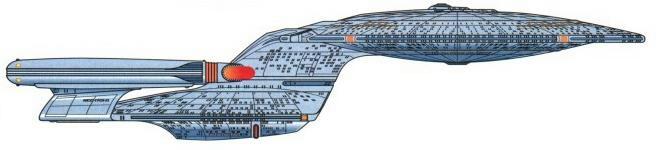
The Galaxy-class began it's development in 2343 with the approval of the project given in July of that year. Starships of this class were designed as the most advanced of their time with a projected total of 12 ships - six being fully constructed and six more completed to the framework stage of construction. Classified as explorers, ships of this class measured about 642 meters (2,106.3 feet) long and were designed with three isolinear computer cores; two in the saucer section and one in the engineering section. These vessels are armed with twelve Type X (10) phaser arrays and three photon torpedo launchers for their defense. Galaxy-class ships are capable of separated flight meaning; the saucer section and the engineering/battle section could operate independently of each other. This would allow the bulk of the ship's population to remain outside a combat area. If in an absolute emergency, the saucer was designed to perform a “slide-out” landing on the surface of a habitable planet. This capability was only computer-simulated and not actually tested during development or construction.
The Galaxy-class prototype, bearing Starfleet registry number NX-70637 (later changed to NCC-70637), was launched in 2356. The prototype was declared deep spaceworthy, warp capable and commissioned as USS Galaxy the very next year. The first production model, bearing the registry number NCC-71807 was commissioned USS Yamato in about 2360. The second Galaxy-class production model, bearing registry NCC-1701-D, would be launched in 2358, leaving Martian orbital dock on manuevering thrusters. The vessel was declared deep spaceworthy and warp capable in 2359 but was not commissioned as USS Enterprise until 05 OCT 2363.
Of the first three Galaxy-class explorers constructed, Enteprise, under the command of Starfleet Captain Jean-Luc Picard, would become the most accomplished, well-known and served as the Federation's flagship during the vessel's short eight years of Starfleet service. During the ship's first mission, the crew of 1701-D would perform the first Galaxy-class saucer separation at high warp velocity during the vessel's journey to Deneb IV and its first contact with Q in 2364. Throughout the ship's career, the crew of the Enterprise would continue to make numerous first contacts with alien species, including the Borg in 2365; surviving four deadly encounters with them, and become intertwined in the internal politics of both the Klingon and Romulan Empires. In 2371, USS Enterprise partially succeeded in performing an emergency landing of its saucer section on a habitable planetary surface when the ship's engineering section was destroyed by a warp core breach. The ship's crew suffered only minor casualities but the saucer could not be salvaged.
Of the first three vessels of the class, only the Galaxy would survive to complete two decades of service to Starfleet and the Federation. The Yamato, unfortunately, would be destroyed by a computer virus during its unauthorized investigation of the ancient and mysterious Iconians and their homeworld of Iconia, deep in the Romulan Neutral Zone in 2365. By 2375, eight Galaxy-class explorers had served or were serving in Starfleet; several of them, including USS Galaxy, served valiantly during the Dominion War of 2373-75. In 2379, four years after the War's end, the Galaxy would be assigned to Battle Group Omega, a task force established and assigned to stop a possible invasion of the Federation from the Remans, a former slave race of the Romulan Star Empire who had overthrown the Romulan government.
Ships of the Class
| CHALLENGER | NCC-71099 |
| ENTERPRISE | NCC-1701-D |
| GALAXY | NX/NCC-70637 |
| MAGELLAN | NCC-71820 |
| ODYSSEY | NCC-71832 |
| TRINCULO | NCC-71867 |
| VENTURE | NCC-71854 |
| YAMATO | NCC-71807 |