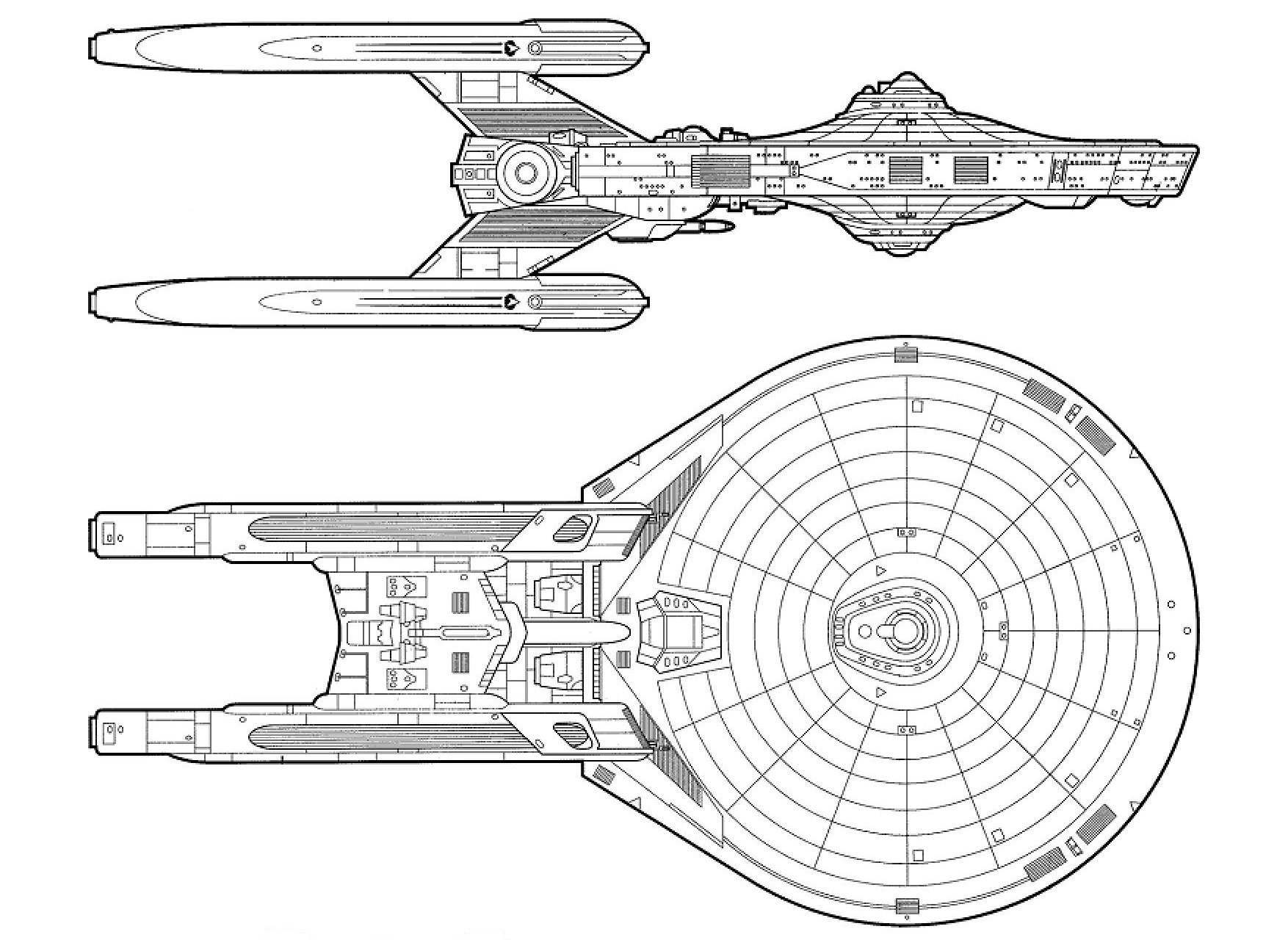
The history of the Constellation-class begins roughly twenty-five years before the commissioning of USS Constellation in 2277. Along with the traditional two-nacelle ships that had been so successful throughout Federation history; Starfleet researched, developed and constructed a number of vessels with one or three warp engine nacelles in the 2250's. However, the development of a four-nacelle ship eluded ship designers and engineers until the late 2260's. In the late ‘60s, a number of innovative leaps in engineering and various technologies occurred. These technological leaps led to renewed research into the concept of a starship with four warp nacelles. Additionally, these leaps allowed for the redesign & refit of nearly all existing starship classes and the creation & construction of new ship classes throughout the 2270's and 2280's.
Amongst the new ship designs authorized for construction in the early 2270's was the prototype ship of the Constellation-class Development Project. The construction of the four nacelle prototype took more than three years. Once completed in 2275, the Constellation-class prototype vessel was launched with the registry number NX-1974. Over the next two years, the experimental ship underwent significant testing, including six shakedown missions. In 2277, the ship would be commissioned as USS Constellation; in honor and memory of the previous ship to bear the name Constellation; a Constitution-class starship lost in the line of duty ten years earlier.
Even after being commissioned in 2277, the Constellation would retain its' experimental prototype status for nearly two decades; spending those years undergoing additional shakedown cruises at various locations throughout Federation space testing experimental equipment that may or may not be included in other Starfleet ships. While the Constellation conducted these extended tests and shakedowns; in order for the primary mission of the class to be fulfilled; that being of deep space exploration of extended duration, lasting up to ten years; one of the earliest operational ships of the Constellation-class entered into Starfleet service eight years after the class prototype. Bearing the unusually high registry number of NCC-2593, the vessel was commissioned as USS Hathaway in 2285.
Due to the nature of that primary mission, the number of Constellation-class ships that entered into service would be small. Besides the Constellation and the Hathaway, the class would include Stargazer, Gettysburg, Victory, among others. The Constellation herself would end its prototype phase and be declared operational in 2295. At that time, the ship's registry was changed to NCC-1974 and the ship would serve Starfleet and the Federation for (at least) the next seventy-five years.
Sixty years later in 2355, the Constellation-class starcruiser USS Stargazer, bearing registry number NCC-2893 and under the command of Starfleet Captain Jean-Luc Picard, was attacked by an unknown hostile vessel while exploring the Maxia Zeta star system. Under Picard's command, Stargazer performed a faster-than-light manuever that gave the ship a tactical advantage, ultimately leading to the hostile's destruction. The significant internal damage and the failure of the ship's life support system led the ship's crew to evacuate and abandon the ship. The crew would be rescued several weeks later and a search for the abandon vessel was conducted but the ship was not found. The manuever that Picard and his crew used would come to be known as “The Picard Manuever”. The fate of USS Stargazer would be unknown for nine years until the ship was delivered by the Ferengi to Picard, commanding the new Galaxy-class USS Enterprise-D.
One year later in 2365, the eighty-year-old starcruiser USS Hathaway and the Enterprise-D were assigned to conduct a battle simulation. As part of the simulation, the Hathaway was stripped down, declared “warp-inactive” and crewed by Enterprise personnel. Following the initial simulated “attack” between the two ships; the simulation was interrupted by a real attack from a Ferengi ship. The attack led to the Enterprise being frozen in simulation mode and unable to defend the Hathaway, which had no offensive weapons. Despite the deadly Ferengi threat, the Enterprise and Hathaway crews devised and executed a solution that led the Ferengi to believe that the Enterprise fired upon and destroyed the Hathaway and another Federation starship was approaching their position; forcing the Ferengi to withdraw. In reality, the Hathaway performed a warp jump mere milliseconds before the Enterprise's torpedoes detonated; despite being declared “warp-inactive”. Following the conclusion of the simulation, the Hathaway was restored to operational status.
Constellation-class ships would serve the Federation and Starfleet through the 2370’s including during the devastating Dominion War, serving as part of a second line of defense.
Ships of the Class
| CONSTELLATION | NX/NCC-1974 |
| GETTYSBURG | NCC-3890 |
| HATHAWAY | NCC-2593 |
| STARGAZER | NCC-2893 |
| VICTORY | NCC-9754 |
| CONSTANCE | NCC-10367 |
NOTES
1.) Much, if not all, of the 23rd Century history of the Constellation-class is conjecture on the part of this webmaster but is based on canon and some non-canon information available through the wikis Memory Alpha and Memory Beta.
2.) Information on the Constance is from Star Trek: Picard's third season end credits. As the webmaster, I am “on-the-fence” on the legitmacy of the show. Admittedly I have not watched Picard's second season, yet did watch the first and third, in order; which is odd of me as a life long Star Trek fan. Oh, well. I'll get to it, eventually.
—LT, January 2026