Space Vessels
20th
Century
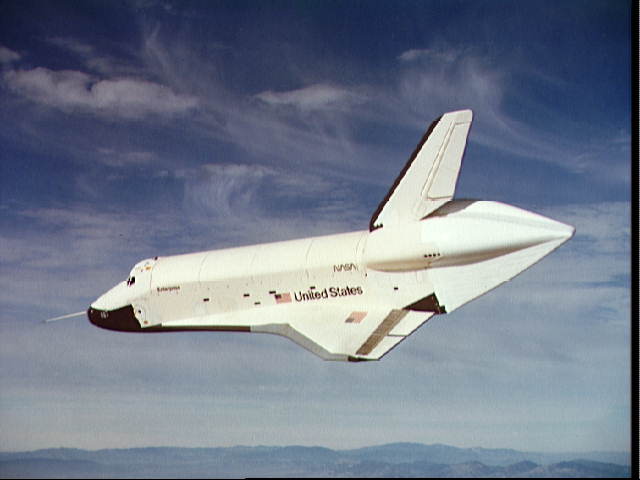 The National Aeronautics and Space Administration (NASA) created and developed
a reusable spacecraft known as the Space Shuttle Orbiter. The first orbiter
was originally named Constitution, but an extensive written campaign
to the White House urged the name to be changed to Enterprise, in honor
of the spaceship from the science fiction show Star Trek. Designated Orbiter
Vehicle (OV) 101, Enterprise was "rolled out of Rockwell's Air Force
Plant 42, Site 1 Palmdale, California assembly facility on Sept. 17, 1976.
The orbiter's main (and only) purpose was to test the Space Shuttle's approach
and landing response. Along with this main purpose, a secondary purpose was to
test the abilities of the Boeing 747 aircraft with the orbiter attached along
with it being attached to the External Tank and Solid Rocket Boosters on a launch
pad at Cape Canaveral. Between the day the orbiter was rolled out and October 30, 1979,
the Enterprise was the test bed for orbiters that were in production and
any future orbiters constructed. On November 18, 1985, Enterprise was
ferried from the Kennedy Space Center to Dulles Airport, Washington, D.C., and
became the property of the Smithsonian Institution.
The National Aeronautics and Space Administration (NASA) created and developed
a reusable spacecraft known as the Space Shuttle Orbiter. The first orbiter
was originally named Constitution, but an extensive written campaign
to the White House urged the name to be changed to Enterprise, in honor
of the spaceship from the science fiction show Star Trek. Designated Orbiter
Vehicle (OV) 101, Enterprise was "rolled out of Rockwell's Air Force
Plant 42, Site 1 Palmdale, California assembly facility on Sept. 17, 1976.
The orbiter's main (and only) purpose was to test the Space Shuttle's approach
and landing response. Along with this main purpose, a secondary purpose was to
test the abilities of the Boeing 747 aircraft with the orbiter attached along
with it being attached to the External Tank and Solid Rocket Boosters on a launch
pad at Cape Canaveral. Between the day the orbiter was rolled out and October 30, 1979,
the Enterprise was the test bed for orbiters that were in production and
any future orbiters constructed. On November 18, 1985, Enterprise was
ferried from the Kennedy Space Center to Dulles Airport, Washington, D.C., and
became the property of the Smithsonian Institution.
(For more information on the orbiters, visit the orbiters web page
through the Shuttle Shuttle Flight Archives section of the Kennedy
Space Center web site, or simply click here)
22nd
Century
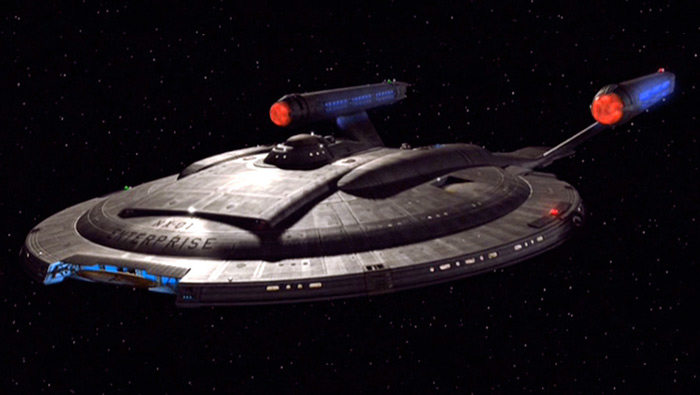 Eighty-eight years after humans achieved warp speed flight, Earth launched
its first starship capable of reaching Warp 5. Earth's Starfleet commissioned
this vessel as Enterprise with a registry number of NX-01. Enterprise
was launched in April 2151 with Captain Jonathan Archer in command.
During it's first year of service, the ship's crew has made first contact with
a half dozen species, notably the Andorians. During that first contact,
the ship's crew revealed that the Vulcans were using a sacred shrine as a listening
post against the Andorians. On 9 February 2152, Enterprise achieved
Warp 5, while on a mission to deliver a Vulcan ambassador back to Vulcan. In
March(?) of the same year, the crew of Enterprise believed that they
caused the death of 3,600 Paraagan colonists. Upon further investigation, the
crew determined that the Suliban were involved in the colony's destruction.
Enterprise was attacked and captured by the Suliban, but the ship and
it's crew escaped by faking a warp core breach.
Eighty-eight years after humans achieved warp speed flight, Earth launched
its first starship capable of reaching Warp 5. Earth's Starfleet commissioned
this vessel as Enterprise with a registry number of NX-01. Enterprise
was launched in April 2151 with Captain Jonathan Archer in command.
During it's first year of service, the ship's crew has made first contact with
a half dozen species, notably the Andorians. During that first contact,
the ship's crew revealed that the Vulcans were using a sacred shrine as a listening
post against the Andorians. On 9 February 2152, Enterprise achieved
Warp 5, while on a mission to deliver a Vulcan ambassador back to Vulcan. In
March(?) of the same year, the crew of Enterprise believed that they
caused the death of 3,600 Paraagan colonists. Upon further investigation, the
crew determined that the Suliban were involved in the colony's destruction.
Enterprise was attacked and captured by the Suliban, but the ship and
it's crew escaped by faking a warp core breach.
Approximately a month later, Enterprise
was approaching a planet to enter orbit when it struck a cloaked mine. The ship
was heavily damaged by the mine. A second mine had attached itself to the ship,
but was later removed from the ship as well as the piece of hull plating that it
was attached and detonated. While an attempt to disarm the mine was taking place,
an unknown vessel appeared in the minefield in Enterprise's flight path.
The ship, along with the mines, were later identified as Romulan.
Enterprise escaped before being fired upon by two Romulan ships. After
four days of repairs, Captain Archer decided to send out a general distress call.
The call was answered by a Tellarite freighter, which directed them to an automated
repair facility. The facility performed three months of repairs in about a day
and a half. Unfortunately, the crew had to destroy the station after repairs were
completed, after the station captured Enterprise's helmsman, Ensign Travis
Mayweather.
In early 2153, Enterprise was retrofitted with enhanced hull
plating and photonic torpedoes to search for the spieces that attacked Earth,
killing seven million people.
"STAR TREK" AND ALL RELATED ELEMENTS ARE TRADEMARKS (REGISTERED, COPYRIGHTED OR OTHERWISE)
BY PARAMOUNT PICTURES, A VIACOM COMPANY
NO COPYRIGHT INFRINGEMENT INTENDED BY WEBMASTER. THIS IS A NOT-FOR-PROFIT WEBSITE.
FOR MORE COPYRIGHT INFORMATION, CLICK HERE
WEBMASTER: LIBRARYTREKKER
ANGELFIRE.COM WEBSITE ESTABLISHED ON: 08 NOVEMBER 2003
MODIFIED: 18 DECEMBER 2003
COPYRIGHT 2003
ALL RIGHTS RESERVED
An affiliate archive site of LibraryTrekker's Webase
Significant code modification made 19 JAN 2020
© 2020 LIBRARYTREKKER ALL RIGHTS RESERVED

