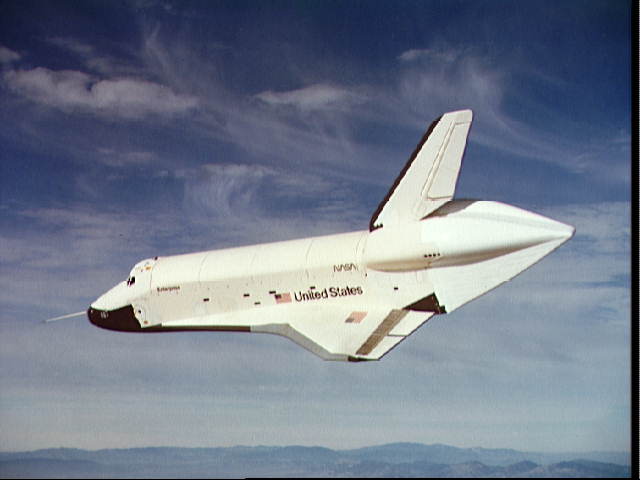
 The National Aeronautics and Space Administration (NASA) and its' contractors
created and developed a reusable spacecraft system known as the Space Transportation System (STS). Better known
as the Space Shuttle, the STS was designed with three main components; the Orbiter, an External Fuel Tank and
two Solid Rocket Boosters. Construction of the first orbiter, which would be the test-bed for all other orbiters,
began in June 1974 and was originally going to be named Constitution, but an extensive write-in campaign
to the White House urged the name to be changed to Enterprise, in honor of the spaceship from the 1960's
science fiction televison show Star Trek. Having been already designated by NASA as Orbiter Vehicle 101
(OV-101), on 17 September 1976 Enterprise was rolled out of Rockwell International's assembly facility
in Palmdale, California. On hand for the roll out was Gene Roddenberry, creator of the television show Star Trek,
and members of the show's cast.
The National Aeronautics and Space Administration (NASA) and its' contractors
created and developed a reusable spacecraft system known as the Space Transportation System (STS). Better known
as the Space Shuttle, the STS was designed with three main components; the Orbiter, an External Fuel Tank and
two Solid Rocket Boosters. Construction of the first orbiter, which would be the test-bed for all other orbiters,
began in June 1974 and was originally going to be named Constitution, but an extensive write-in campaign
to the White House urged the name to be changed to Enterprise, in honor of the spaceship from the 1960's
science fiction televison show Star Trek. Having been already designated by NASA as Orbiter Vehicle 101
(OV-101), on 17 September 1976 Enterprise was rolled out of Rockwell International's assembly facility
in Palmdale, California. On hand for the roll out was Gene Roddenberry, creator of the television show Star Trek,
and members of the show's cast.
Between February and November 1977 NASA utilized Enterprise for the Approach and Landing Tests, or ALT, program. The purpose of the program was primarily to test the orbiter's approach and landing response. Also as part of ALT, Enterprise was used to test the abilities of a modified Boeing 747 aircraft, with the orbiter attached, to serve as the Shutlle Carrier Aircraft, or SCA. The SCA would serve as a ferry for the orbiters between NASA facilities or other locations. Once ALT was completed, ground vibration tests were conducted with Enterprise mated to the External Tank and Solid Rocket Boosters at NASA's Marshall Space Flight Center between March 1978 and March 1979. At the Kennedy Space Center in Cape Canaveral, Florida, Enterprise would again be attached to the External Tank and Solid Rocket Boosters on a launch pad for more testing and evaluation.
Completing its' “mission” as the test bed for orbiters that were in production and any future orbiters on 30 October 1979, the Enterprise was placed in storage until the 1984 Louisiana World Exposition (World's Fair) in New Orleans. The orbiter test-bed was transported to the Exposition and placed on display for the duration. Once the Exposition was over, Enterprise was placed back in storage until 18 November 1985. On that day, Enterprise was ferried from the Kennedy Space Center in Florida to Dulles International Airport outside Washington, D.C., and became the property of the Smithsonian Institution.
Following the destruction of Challenger (OV-099) on 28 January 1986, NASA considered requesting the return of the Enterprise from the Smithsonian Institution and refitting the orbiter test-bed for space flight. However NASA determined that the cost would be too high to refit Enterprise. NASA chose to replace Challenger by building a new orbiter out of spare parts, resulting in the Space Shuttle Endeavour (OV-105).
Following the loss Space Shuttle Columbia (OV-102), which broke up during re-entry on 1 February 2003; an investigation was conducted by an independent board and NASA to determine what caused Columbia's destruction. The provailing theory devised by the investigation was that foam from the External Tank impacted the edge of Columbia's left wing during launch leading to the break up of Columbia during re-entry. To test their theory, the investigative team used parts of the leading edge of both of Enterprise's wings to test whether or not foam from the External Tank could penetrate the material of the wing's leading edge, thus exposing the internal frame of the wing to hot atmospheric gases. The tests that were conducted conclusively proved the investigation's theory, leading to further safety protocols enacted for future STS missions.
After nearly twenty years of exposure to the elements in an open hanger near Dulles International Airport outside Washington, DC Enterprise was restored and moved into the Smithsonian Institution's Air and Space Museum's Steven F. Udvar-Hazy Center in 2003. For nearly nine years Enterprise would serve as the centerpiece of the Center's space collection, sitting alongside other famous air and space craft including the SR-71 Blackbird supersonic jet, the Boeing B-29 'Enola Gay' and the Gemini 7 capsule.
After 30 years of service to the United States, the Space Shuttle program came to an end in 2011. On 12 April 2011, 30 years after the first Space Shuttle launch, NASA announced the locations that the individual shuttle orbiters would spend their retirement once the final shuttle mission, STS-135, was completed by Shuttle Atlantis (OV-104) in July 2011. Enterprise would be moved from its home at the Udvar-Hazy Center to the Intrepid Sea, Air & Space Museum in New York City while Discovery (OV-103) took Enterprise's place at the Udvar-Hazy Center.
On 19 April 2012, Enterprise was rolled out of its' home at the Udvar-Hazy Center and briefly sat along side its sister ship and replacement at the muesum, Space Shuttle Discovery (OV-103). Using NASA's Shuttle Carrier Aircraft or SCA, Enterprise was flown from Dulles International Airport to John F. Kennedy International Airport in New York City. In June, the shuttle was transported to the Intrepid Museum by barge from the airport up the Hudson River and hoisted onto the flight deck of the former World War II aircraft carrier.
Under an inflatable pavilion on the flight deck of the aircraft carrier-turned-museum, Enterprise (OV-101) opened to the public as part of the Intrepid Sea, Air & Space Museum on 19 July 2012. Three months later, the Muesum and in particular OV-101, would suffer damage due to Hurricane Sandy. On 29 October 2012, storm surges from the hurricane cut power to the muesum and its backup generators failed resulting in the collapse of the inflatable pavilion and damage to the orbiter, specifically its vertical stabilizer. The damage to the orbiter and the muesum as a whole was repaired with Enterprise and its “Space Shuttle Pavilion” reopening to the public on 19 July 2013. During the repairs conducted on the orbiter, on 13 March 2013, “in recognition of its role in the development of the Space Shuttle Program”, the Enterprise was listed on the National Register of Historic Places.[source]
Despite never reaching space, Enterprise inspired hundreds of thousands, if not millions, who had seen the craft each and every year between 2003 and 2012 at the Udvar-Hazy Center and will continue to inspire thousands more at the Intrepid Sea, Air & Space Museum, its current home in New York, for years, if not decades to come.
NOTE: For more information on the Space Shuttle orbiters, visit the Space Shuttle page of the NASA website.