Works Cited
Star Trek - The Original Series, would not have been possible without the imaginations of its' creator, Gene Roddenberry, and the talents of writers, producers, directors, actors and every other individual involved in the show's production to make it a reality every week during the series run in the 1960's. One of these important individuals was Art Director Walter "Matt" Jefferies. He was responsible for designing sets and props during the show's production run. Jefferies' most important contribution however came in 1964 when Roddenberry asked him to create the show's most essential "star". This "star" was none other than the "star"ship itself. Roddenberry gave the ship it's name (originally Yorktown), but Jefferies created its' design; a saucer-shaped primary hull connected to a cynlindrical secondary hull with two "warp" engines attached. Not only is Jefferies responsible for Enterprise's design but also for the ship's famous number, NCC-1701.
The design was completed but only, on paper, in two dimensions. To give Roddenberry an idea what the ship would look like in "real life", an approximate three-foot balsa wood and cardboard model was built by either professional modelbuilder, Richard C. Datin or Matt Jefferies, himself. This "three-footer" model was never intended for film, be it still or motion, however, the model was used for publicity photos with William Shatner and Leonard Nimoy in costume and some visual effects shots. Unfortunately, the "three foot" model would become lost to history sometime after the end of the show's production.
 With Gene's initial approval of the "three-footer", construction began on the filming model (or miniature) in
November of 1964. Under Datin's supervision, the filming miniature was constructed by Vern Sion and Mel Keys at
Velmor Jensen's Production Models Shop in (or near) Burbank, California, USA. Construction of the miniature took
approximately six weeks and the cost of materials at that time was about $600.00 with the overall cost to build the
model being $3,000. Materials used to build the model can be found in the list below. Among the various sources used
for this page, the information provided on the type of paint used on the miniature when it was built is contradictory.
One source indicates that the type of paint used was a custom-made, non-gloss lacquer grey-colored paint with a light
tint of green. Another source suggests that the color of paint used on the model was the same grey color used on 1964
model Ford pick-up trucks. When the model was completed and "delivered" on 29 DEC 1964, it was transferred to the
Howard Anderson Company for visual effects filming for the first, then second pilot episodes. In order for the
"11-foot" miniature to be transported, it could be disassembled into three parts: the primary hull (saucer), the
secondary hull and the engine nacelles & pylons. Based on the concerns of Gene Roddenberry and/or others, who
considered the model "too clean" or "too static", modifications to the miniature were done in late summer of 1965,
spring of 1966 or both, after the filming of the second pilot had been completed. These modifications included window
lights, lightly penciled-in "deflector grid" and the spinning effect on the front of the engine nacelles inside new
Plexiglass caps. Prior to these modifications however, stock footage of the model had been taken at the Howard
Anderson Company and subsequentually used during production of the regular series episodes. According to Mr. Howard
Anderson, Jr. the Star Trek Art Department would continually add details to the miniature throughout the time
of the series' production. An interesting factoid about the model is that the port or left side of the model's
secondary hull and engine support pylon were "finished" without the modifications (i.e. window lights) because the
electrically wiring that powered the miniature was attached through this side of the model. This also resulted in the
port side almost never appearing on film.
With Gene's initial approval of the "three-footer", construction began on the filming model (or miniature) in
November of 1964. Under Datin's supervision, the filming miniature was constructed by Vern Sion and Mel Keys at
Velmor Jensen's Production Models Shop in (or near) Burbank, California, USA. Construction of the miniature took
approximately six weeks and the cost of materials at that time was about $600.00 with the overall cost to build the
model being $3,000. Materials used to build the model can be found in the list below. Among the various sources used
for this page, the information provided on the type of paint used on the miniature when it was built is contradictory.
One source indicates that the type of paint used was a custom-made, non-gloss lacquer grey-colored paint with a light
tint of green. Another source suggests that the color of paint used on the model was the same grey color used on 1964
model Ford pick-up trucks. When the model was completed and "delivered" on 29 DEC 1964, it was transferred to the
Howard Anderson Company for visual effects filming for the first, then second pilot episodes. In order for the
"11-foot" miniature to be transported, it could be disassembled into three parts: the primary hull (saucer), the
secondary hull and the engine nacelles & pylons. Based on the concerns of Gene Roddenberry and/or others, who
considered the model "too clean" or "too static", modifications to the miniature were done in late summer of 1965,
spring of 1966 or both, after the filming of the second pilot had been completed. These modifications included window
lights, lightly penciled-in "deflector grid" and the spinning effect on the front of the engine nacelles inside new
Plexiglass caps. Prior to these modifications however, stock footage of the model had been taken at the Howard
Anderson Company and subsequentually used during production of the regular series episodes. According to Mr. Howard
Anderson, Jr. the Star Trek Art Department would continually add details to the miniature throughout the time
of the series' production. An interesting factoid about the model is that the port or left side of the model's
secondary hull and engine support pylon were "finished" without the modifications (i.e. window lights) because the
electrically wiring that powered the miniature was attached through this side of the model. This also resulted in the
port side almost never appearing on film.
Production on Star Trek ended in early 1969 when NBC cancelled the show and the final episode entitled "Turnabout Intruder" aired on 03 JUN 1969, six weeks before man landed on the moon. The filming miniature was transferred from Howard Anderson to Paramount Pictures' Props Department were it was stored, unpacked, for virtually five years. There is only one documented instance of the model being lent out by the Props Department in April, 1972. This instance can be read about at The IDIC Page's "The Voyage to the Bottom of the Starship Enterprise Miniature".
Nearly two years later in February, 1974, Paramount donated the "11 foot" miniature as a gift to the Smithsonian Institute's National Air and Space Museum (NASM). The model received a three month renovation at NASM's Silver Hill restoration facility in Maryland, today known as the Garber Facility between late April and July of 1974. This first renovation involved replacing lost parts of the miniature and repairing damage to the model. For the next ten years the model would be on display in two different exhibits. These exhibits were in Galleries 107 ["Life in the Universe" (1974-79)] and 113 ["Rocketry and Spaceflight" (1979-84)]. In August of 1984, NASM personnel removed the miniature from display to undergo a second renovation. The second renovation replaced most of the model's internal wiring and sealed the electrical wiring intrusions into the secondary hull of the model with molded air tubing. Also the "spinning lights" effect had been partially restored to the model. Between September 1984 and September 1985, the Enterprise filming miniature was on display in Gallery 211 ("Flight and the Arts") during the Art of Robert McCall Exhibition. Once the exhibition ended the model was returned to Gallery 113. For the next six years the model would be on display until it was removed for another renovation in late 1991.
To celebrate Star Trek's 25th Anniversary, NASM planned a retrospective
exhibit during 1992. NASM personnel felt that the centerpiece of the exhibit - the model - required a third
renovation. This renovation would not be a small challenge but a monumental one. NASM contracted the renovation to Ed
Miarecki of the Springfield, Massachusetts-based SFMA Modelers. Prior to the renovation, Mr. Miarecki's credentials
include work on the motion pictures Star Trek V: The Final Frontier &
 Star
Trek VI: The Undiscovered Country and on the TV show Star Trek: The Next Generation. Under contract Mr.
Miarecki was to renovate the entire miniature except the dorsal (topside) portion of the saucer which had been
virtually untouched since Paramount donated the model in 1974. Ken Isbell from NASM supervised Miarecki during the
renovation which began on 10 DEC 1991 and would be completed six weeks later on 24 JAN 1992. During the renovation
process, Isbell would contact Miarecki by telephone and occasionally received "a dose of profanity", especially if
the process was not going well. The miniature, including the Decks 2 & 3 wooden teardrop on the top of the saucer,
received new paint, refurbished lighting and a fully restored "spinning lights" effect on the front of the engine
nacelles. Also the "deflector grid" which had been lightly penciled on in the late sixties would be heavily
emphasized. The restored filming miniature of the USS Enterprise went on display for the 25th Anniversary
Exhibition on 28 FEB 1992. Orginially scheduled to end on 07 SEPT 1992, the exhibition continued until the end of
January, 1993. Once the exhibition ended the model was placed in storage for the next seven years! In March
2000 NASM removed the model from storage, putting it back on display. Instead of returning the model to Gallery 113,
where the model was located prior to the 1991 renovation, it was placed inside an extra large glass case on the lower
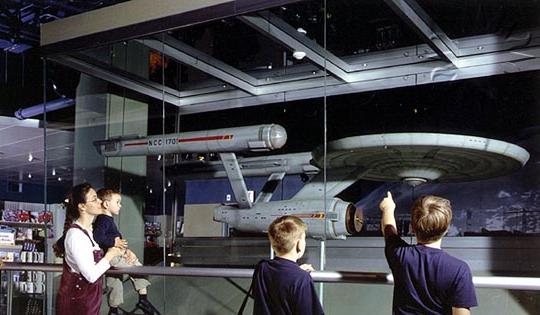
level of the muesum's gift shop, where the miniature resides to this day.
Star
Trek VI: The Undiscovered Country and on the TV show Star Trek: The Next Generation. Under contract Mr.
Miarecki was to renovate the entire miniature except the dorsal (topside) portion of the saucer which had been
virtually untouched since Paramount donated the model in 1974. Ken Isbell from NASM supervised Miarecki during the
renovation which began on 10 DEC 1991 and would be completed six weeks later on 24 JAN 1992. During the renovation
process, Isbell would contact Miarecki by telephone and occasionally received "a dose of profanity", especially if
the process was not going well. The miniature, including the Decks 2 & 3 wooden teardrop on the top of the saucer,
received new paint, refurbished lighting and a fully restored "spinning lights" effect on the front of the engine
nacelles. Also the "deflector grid" which had been lightly penciled on in the late sixties would be heavily
emphasized. The restored filming miniature of the USS Enterprise went on display for the 25th Anniversary
Exhibition on 28 FEB 1992. Orginially scheduled to end on 07 SEPT 1992, the exhibition continued until the end of
January, 1993. Once the exhibition ended the model was placed in storage for the next seven years! In March
2000 NASM removed the model from storage, putting it back on display. Instead of returning the model to Gallery 113,
where the model was located prior to the 1991 renovation, it was placed inside an extra large glass case on the lower
level of the muesum's gift shop, where the miniature resides to this day.
Building materials used for the USS Enterprise "11-foot" filming miniature. (broken down into sections)
- Primary Hull
- Royalite vacuum-formed plastic
- series of wooden ribs hold plastic together
- Secondary Hull
- Built up sections of Sugar Pine Wood
- Nacelles & Pylons
- Hemisphere caps: Wood, painted red? w/ gold sensor spikes; later changed to sandblasted Plexiglass w/ rotating metal fins & Christmas lights
- Forward of and at Pylons: Wood (unknown kind)
- Aft of Pylons: Wooden ribs supporting thin, rolled sheet metal
- Nacelle Details (i.e. intercoolers): Wood (unknown kind)
- Pylons: Some sort of Hardwood such as oak or walnut
The following table shows measurements of the Enterprise filming miniature provided from NASM and The IDIC Page.
NASM |
NASM (converted) |
IDIC |
IDIC (converted) |
|
|---|---|---|---|---|
| Overall Length | 3.3 m |
129.92 in |
134 in |
3.40 m |
| Saucer Diameter | 152 cm |
59.84 in |
60 in |
152.40 cm |
| Nacelle Length | 185 cm |
72.83 in |
72.25 in |
183.52 cm |
| Secondary Hull Length | 135 cm |
53.15 in |
53.50 in |
135.89 cm |
| Height | 80 cm |
31.50 in |
N/A |
N/A |
| Weight | 90 kg |
198.42 lbs |
220 lbs |
99.79 kg |
